


October 18, 2026
Revised Common Lectionary
Exodus 33:12-23 or Isaiah 45:1-7
Psalm 99 or Psalm 96:1-9 (10-13)
1 Thessalonians 1:1-10
Matthew 22:15-22
Lectionary for Mass (RC)
Isaiah 45:1, 4-6
Psalm 96:1, 3, 4-5, 7-8, 9-10 (7b)
1 Thessalonians 1:1-5b
Matthew 22:15-21
On this Sunday in the United States, we find ourselves just over two weeks away from a contentious midterm election. The stakes are high, as control of both the House and Senate is in play. Appropriately enough, we hear today a Gospel reading in which Jesus is questioned about what we owe to civil authority, giving us the opportunity to consider how our faith relates to political life today.
The questioners who approach Jesus are hardly sincere seekers of wisdom and truth. The group includes disciples of the Pharisees, who viewed paying the Roman tax as problematic on religious grounds, and the Herodians, who supported the payment of taxes because they were adherents of Herod Antipas, a Roman-installed ruler.
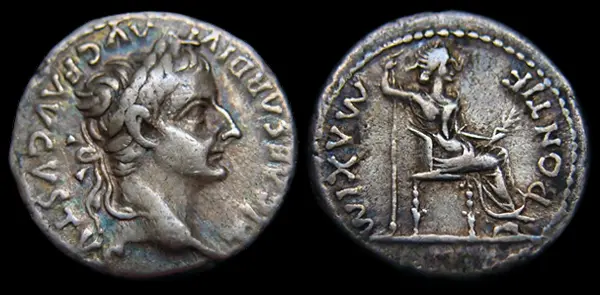
Their query is a trap: “Is it lawful to pay taxes to the emperor, or not?” (Mt 22:17) If Jesus were to say no, he would be guilty of sedition against the Roman state. If he were to say yes, then he would appear to be contradicting Jewish law, since the coin used to pay the tax carried not only the image of Caesar but an inscription identifying him as “son of the divine Augustus,” and was thus considered by the Pharisees to be blasphemous.
Jesus sidesteps the trap set for him in his famous reply: “Render therefore to Caesar the things that are Caesar’s, and to God the things that are God’s” (Mt 22:21, RSV). While he declines to give a political answer, this short saying of Jesus has guided Christians ever since in navigating their responsibilities toward civil authority and involvement in affairs of state.
The Greek verb translated as “render” (RSV), “give” (NRSV), or “repay” (RNAB) implies some level of obligation, and so Jesus’s reply suggests that civil authorities have a legitimate claim to some measure of adherence. Still, the second part of his response—about giving to God what is God’s—places a clear limitation on that claim.
The early Christian writer Tertullian (c. 155 – c. 220) interpreted Jesus’s words to mean that we should render “the image of Caesar, which is on the coin, to Caesar, and the image of God, which is on the human person, to God” (On Idolatry 15). Christians and Jews alike affirm that God created humans in the divine image (see Gen 1:27). We recognize as well that all creation bears the image of the Creator. To render to God what is God’s is to care for everything that bears the divine likeness, including this planet and everything that lives on it.
More recently, biblical scholars have understood this saying of Jesus in light of the eschatological context of his ministry, always pointing to and preparing for the coming reign of God. Jesus proclaimed in word and deed a new order in which the world as we know it is turned upside down, the poor and the lowly are exalted, the stranger is welcomed, and the rich and powerful are cast down. In this context, Jesus’s teaching might be viewed as subversive or even revolutionary, claiming allegiance for God’s reign over the sovereignty of any civil authority.
What are the implications of Jesus’s teaching for citizens facing the coming election? For the Jews of Jesus’s time, collusion or accommodation were the only means of participation in the affairs of government. Unlike them, citizens of the U.S. and Canada have a voice in choosing leaders and helping to set the policies and direction of government. Jesus never advocated disengagement from the world, and the example of the biblical prophets gives evidence of deep involvement in seeking to influence the nation’s leaders.
Voting and ensuring that the vote is available to all are fundamental ways for Christians to give witness to God’s reign in the public arena. Followers of Jesus vote with the mind of Christ, giving priority to the poor, the weak, and the vulnerable, caring for the earth and its resources, and seeking a just society that embraces the values of God’s reign. Like the prophets who often spoke out against civil authority, voting offers us an opportunity to say no to leaders and policies that stand in the way of justice, compassion, and equality.
We vote with God’s reign in mind: “Render therefore to Caesar the things that are Caesar’s, and to God the things that are God’s” (Mt 22:21, RSV).
A Hymn for Today: “Baited, the question rose”
Carl P. Daw Jr., FHS, has created a hymn text based on today’s Gospel reading that goes far beyond retelling the story. As we sing Daw’s poetry, we also engage in interpreting the Gospel message. In the final two stanzas, we echo the teaching of Tertullian on the divine image imprinted “in ev’ry heart and face” as together we discern how to live out the command to give God what is God’s each day. Listen here.
Baited, the question rose
From somewhere in the crowd:
“Teacher, you truly know God’s way;
Is paying tax allowed?”
Jesus perceived their trap;
“Why do you test me so?
Bring here the coin the tax requires,
And see what it will show.”
“Whose image does it bear,
Whose names and titles tell?”
“Caesar’s, of course,” they smugly said
And thought they answered well.
“Give Caesar what is his;
God, what is God’s alone.”
Strong words, convincing and profound,
Like truth already known.
May we discern, O God,
Your daily gifts of grace;
Show us your image freely coined
In ev’ry heart and face.
Help us fit tribute yield
Through prayers and hymns we raise,
But most of all by deeds of love
To give you thanks and praise.
Text: Carl P. Daw Jr., © 1996 Hope Publishing Co. Used by permission under OneLicense #A-729857.
Tunes: ST. BRIDE, DIADEMATA
Image Credit: Denarius Coin of Tiberius, DrusMAX, CC BY-SA 3.0 via Wikimedia Commons



To receive these weekly reflections by email, please send a message to office@thehymnsociety.org and type “Lectionary” in the subject line.