
July 5, 2026
Revised Common Lectionary
Genesis 24:34-38, 42-49, 58-67 or Zechariah 9:9-12
Psalm 45:10-17 or Song of Solomon 2:8-13 or Psalm 145:8-14
Romans 7:15-25a
Matthew 11:16-19, 25-30
Lectionary for Mass (RC)
Zechariah 9:9-10
Psalm 145:1-2, 8-9, 10-11, 13-14 (see 1)
Romans 8:9, 11-13
Matthew 11:25-30
In the United States, this weekend marks the 250th anniversary of the nation’s independence. More than an occasion for fireworks and other forms of festivity, this anniversary is an opportunity to reflect on how well the nation is living up to its founding ideals. This past week’s national holiday in Canada likewise provides a moment for self-reflection in the midst of celebration.
For those of us who profess faith in Christ, these holidays provide a moment to consider the role we play in shaping the direction of our respective nations in light of the Gospel message. The teachings of Jesus about the reign of God – teachings that call us to justice, compassion, and human dignity – resonate deeply with values embraced by people of many faiths and by people of good will who hold no religious faith at all.
How does today’s Gospel reading address the nature and use of power in the world? Jesus identifies himself not as a great conqueror or warrior, but as “gentle and humble of heart” (Mt 11:29). In the reign of God, the ways of God are revealed not to the wise and the intelligent, but to “infants” (Mt 11:25, NRSV) or “the childlike” (RNAB) – meaning the poor in spirit, the meek, the sorrowing, and the other “blessed” ones that Jesus had identified in the beatitudes (Mt 5:3-12). These little ones have pride of place in the reign of God. Yes, embracing God’s ways of justice and compassion will sometimes lead to misunderstanding, rejection, even persecution. Yet even though the yoke of discipleship brings its own hardships, his yoke is easy and his burden is light.
This vision of humble, liberating power had been expressed hundreds of years earlier in the preaching of the biblical prophets. In today’s first reading, for example, the prophet Zechariah portrays the messianic king entering the city not like a military conqueror on horseback, but rather as a humble bringer of peace astride a domestic animal. This messianic figure eschews the chariot, the bow, and other implements of warfare, and instead signals a universal order of peace. The triumph of this messiah leads not to subjugation but to liberation for the prisoner and the exile. This one rules in the likeness of the God whose praise we sing in today’s psalm: “The Lord upholds the falling, and raises up all who are bowed down” (Ps 145:14).
On this first weekend of July, as both Canada and the United States celebrate national holidays, the Scripture readings challenge us to consider the kind of society that we aspire to be. Can followers of Jesus remain faithful to the Good News of the donkey-riding, peace-bringing, prisoner-liberating Messiah, while still embracing the spirit of “my nation first,” victimizing people of color, excluding immigrants, conquering through intimidation and military might, and dividing nations one against another? How do twenty-first century disciples follow in the footsteps of Christ, the bringer of peace and compassion, as they celebrate a nation that they love?
A Hymn for Today: “Woza nomthwalo wakho / Come, Bring your burdens to God”
This traditional South African song was transcribed from the singing of the Mooiplaas congregation. It was originally sung by a people who had experienced Apartheid and knew well the experiences of exclusion and persecution. It provides a perfect response to the invitation of Jesus in today’s Gospel reading to those who are burdened. Listen here.
Xhosa:
Woza nomthwalo,
oh, woza nomthwalo;
oh, woza nomthwalo,
thwalo wakho;
woza nomthwalo wakho,
u Jesu aka so za thi hay.
English:
Come, bring your burdens,
oh, come, bring your burdens,
oh, come, bring your burdens,
burdens to God;
come, bring your burdens to God,
for Jesus will never say no.
Text: Xhosa; from the singing of the Mooiplaas congregation (South African); trans. Barbara Clark (Scotland); Mairi Munro (Scotland), and Martin Stemerick (Scotland). © 2008 WGRG, Iona Community, admin. GIA Publications, Inc. Used by permission under OneLicense #A-729857
Music: from the singing of the Mooiplaas congregation; trans. Weilile Sigabi (South Africa)
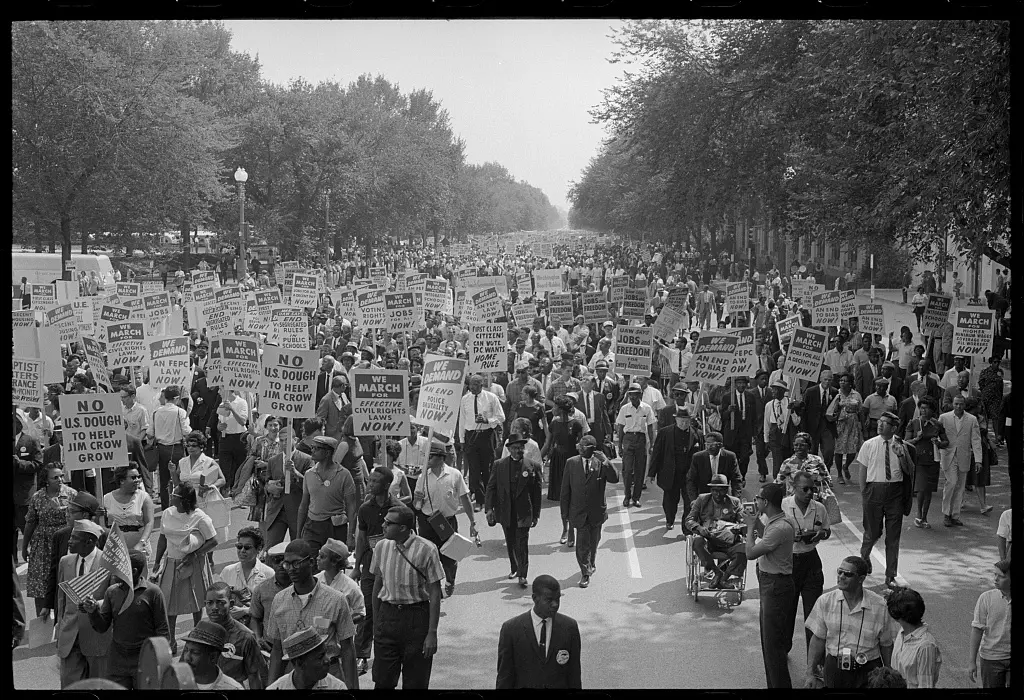
Image Credit: Man in a wheelchair at the March on Washington, 1963, Warren K. Leffler, photograph, Library of Congress
 “Word and Song: A Lectionary Reflection” is written by the Executive Director of The Hymn Society, Rev. Dr. Mike McMahon. For his full bio, click here and scroll down to the “staff” section.
To receive these weekly reflections by email, please send a message to office@thehymnsociety.org and type “Lectionary” in the subject line.