
December 28, 2025
Revised Common Lectionary
Isaiah 63:7-9
Psalm 148
Hebrews 2:10-18
Matthew 2:13-23
Lectionary for Mass (RC)
Sirach 3:2-6, 12-14
Psalm 128:1-2, 3, 4-5 (see 1)
Colossians 3:12-17 (18-21)
Matthew 2:13-15, 19-23
During the week prior to December 28, Christian churches will celebrate Christmas, the Nativity of the Lord. For a Word and Song reflection for Christmas Eve/Night, click here.
Ismael and Fatima Barakat and their family were among the thousands of Syrians who fled from civil war in their homeland to find safety in Lebanon near Beirut. They could not have known that violence would pursue them even there as the conflict between Israel and Hezbollah intensified.
One day the family was at home with Ismael’s father and brother preparing for breakfast when their house was hit by an Israeli airstrike that leveled it. Fatima, the mother, and Noor, the oldest child, were seriously injured and would require several surgeries. Ismael had been out buying bread, but rushed home, only to find three of their daughters and his father and brother dead under the rubble of their home.
Overcome with grief, Ismael lamented, “We fled Syria to seek safety from that war, so I could secure a better life for my family, hope. What’s hope? I lost my father, my brother, my kids. I lost hope in everything.” (Source: PBS Newshour, November 26, 2024)
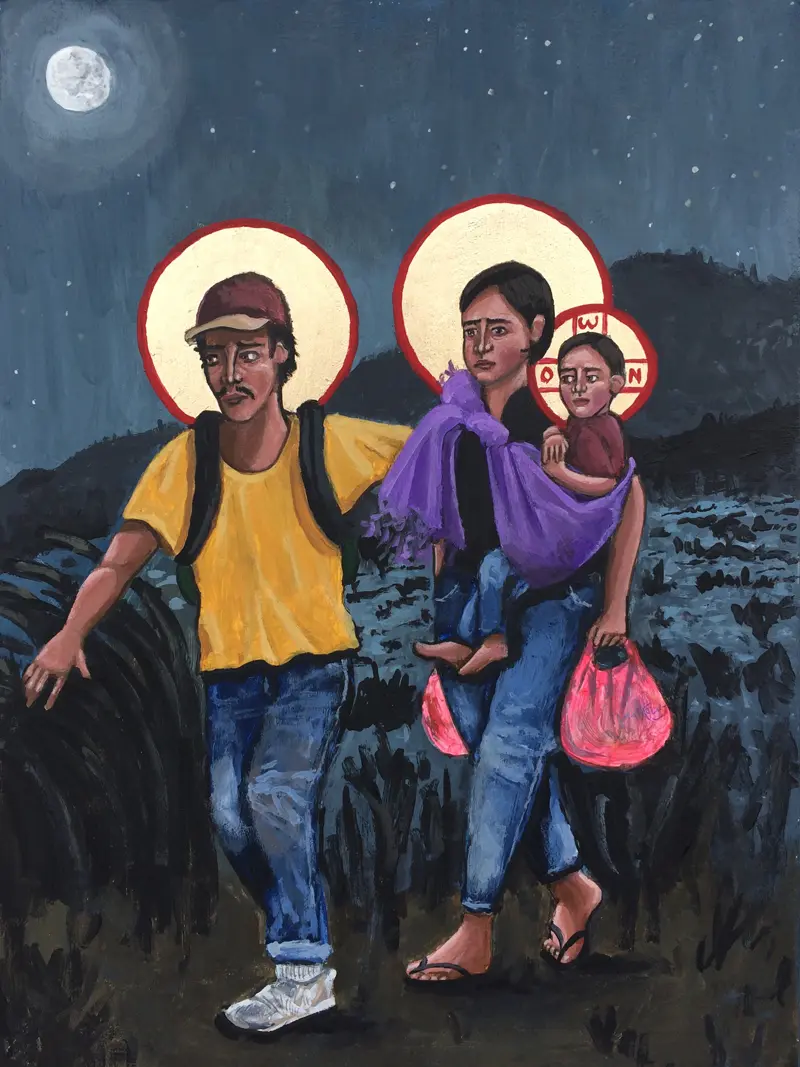
Like the Barakat family from Syria, the Holy Family of Jesus, Mary, and Joseph had to flee their home to escape violence and death. Joseph was warned in a dream that King Herod, fearful of any challenge to his power, was seeking to kill the child for whom the magi had been searching. The angel instructed Joseph to move quickly and take the child and his mother to a foreign country where they would be safe from Herod’s deadly designs.
Meanwhile, the king was sending soldiers to Bethlehem with orders to kill all the male children under two years of age. Matthew quotes the prophet Jeremiah to describe the grief of parents like Ismael and Fatima over the loss of their children: “A voice was heard in Ramah, wailing and loud lamentation, Rachel weeping for her children; she refused to be consoled, because they are no more” (Mt 2:18; Jer 31:15). The prophet wrote these words centuries before Matthew quoted them, but they could have been written for Ismael and Fatima.
Jesus and his family remained in Egypt until Joseph received another dream in which he was told that Herod had died and that he could return to his homeland. As they made their way back, however, Joseph learned in yet another dream that Herod’s son Archelaus had assumed the throne, and so instead of returning to Judea, they traveled to Nazareth, an insignificant town in Galilee, which is named as the hometown of Jesus in all four of the Gospels.
Today’s Gospel proclaims Jesus as a refugee, whose family life was deeply affected by the uncertainty, fear, and hope that drive migrants to seek safety in other nations. The Holy Family was much like the Barakats and the 42.5 million people in the world today who have left their own countries to escape conflict, persecution, or other dangers (Source: UNHCR, June 2025).
The story we hear today demands we ask how the nations of the world are called to respond to the widespread displacement of people escaping threats to their safety and well-being. The teachings of Christianity and Judaism both affirm that the stranger among us is to be treated with dignity. As Pope Leo XIV recently pointed out, one of the criteria by which Jesus tells us that we will be judged is whether or not we welcomed the stranger. The Gospel leaves no room here for brutal treatment or mass deportations. Nations have the right to take reasonable steps to secure their borders against danger, yes—but they also have the responsibility to treat each migrant with respect and dignity and to extend welcome to those in need of refuge.
As we continue to celebrate the Christmas mystery today, we remember that the Word-made-flesh came among us in a refugee family and is with us still in the poor and displaced of this world. The Gospel tells us the Holy Family eventually found a home in Nazareth. For millions like the Barakats, that day has not yet come. Let us extend welcome to the holy families that seek refuge among us today.
A Hymn for Today: “A weary couple”
Mennonite hymnwriter Adam M. L. Tice, FHS, created this text a few years ago in response to a European refugee crisis. It draws on today’s Gospel story to express the anguish of those who have been driven from their homes and hope sparked by the coming of Christ who has embraced their life. Tice wrote this text with the tune LONDONDERRY AIR in mind. Listen here as composer Tony Alonso performs his own arrangement of this poignant and powerful hymn.
A weary couple lodged within a stable,
the only space where they could spend the night.
Were other trav’lers happy to be able
to keep her labor out of mind and out of sight?
But choirs of angels heard the mother’s weeping,
and heaven rang with songs of peace on earth.
They went unheard by those in comfort sleeping,
for Jesus came among the outcasts at his birth.
An angel came to Joseph in his dreaming
and warned him so his family could flee.
As they escaped king Herod’s evil scheming,
the son of God became a refugee.
How many children die without such warning?
How many mothers will not be consoled,
their voices choked with anger, tears, and mourning,
for songs unsung and stories never to be told?
Ooo___
Ooo___
Ooo___
Ooo___
But still the angels sing their hymn of “Glory”
beyond our fears that never seem to cease.
For Christ has come, and God’s unfolding story
redeems the world to live in love, good will, and peace.
Text: Adam M. L. Tice, © 2015 GIA Publications, Inc. Used by permission under OneLicense #A-729857.
Tune: LONDONDERRY AIR
Image: La Sagrada Familia, Kelly Latimore, 2016
 “Word and Song: A Lectionary Reflection” is written by the Executive Director of The Hymn Society, Rev. Dr. Mike McMahon. For his full bio, click here and scroll down to the “staff” section.
To receive these weekly reflections by email, please send a message to office@thehymnsociety.org and type “Lectionary” in the subject line.