
September 27, 2026
Revised Common Lectionary
Exodus 17:1-7 or Ezekiel 18:1-4, 25-32
Psalm 78:1-4, 12-16 or Psalm 25:1-9
Philippians 2:1-13
Matthew 21:23-32
Lectionary for Mass (RC)
Ezekiel 18:25-28
Psalm 25:4-5, 6-7, 8-9 (6a)
Philippians 2:1-5 (6-11)
Matthew 21:28-32
You may be familiar with this saying that I heard my mother repeat many times: “Don’t answer a question with a question.”
When we meet Jesus in today’s Gospel reading, he is ignoring my mother’s sage advice. He responds to a query from religious leaders in Jerusalem with a question—and a challenge—of his own.
Prior to the story we hear today, Matthew recounts how Jesus had entered the city on a donkey to the cheering hosannas of the crowds, then went into the Temple area and created quite a disturbance—toppling the tables of money changers and the seats of merchants—then healing the blind and lame who approached him. All the attention that he attracted through his arrival in the city, cleansing of the Temple, and works of healing, both alarmed and angered those who had charge of religious matters in Jerusalem. Not only were his very public actions a direct challenge to their authority but were also likely to arouse the concern of the Roman occupiers.
And so, they question him: “By what authority are you doing these things, and who gave you this authority”? (Mt 21:23) Without skipping a beat, Jesus silences them by posing a question that they dared not answer: Was the baptism of John of divine or human origin? In this case, answering a question with a question turned out to be a successful strategy.
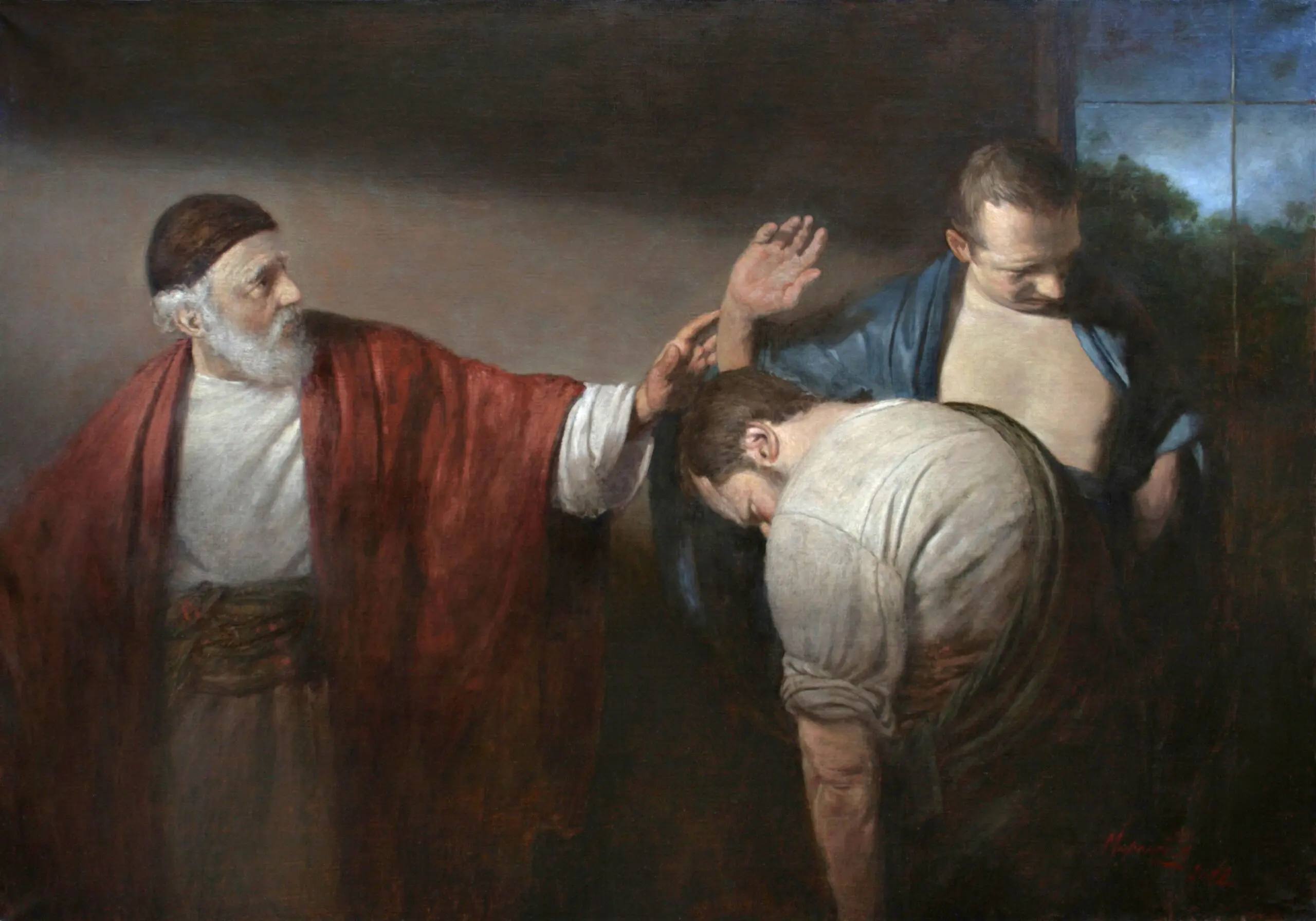
Jesus skillfully turns their questioning of his authority back on the religious leaders. It is now their authority that is being questioned. The terse parable that Jesus goes on to tell is a stinging critique of these elders and their lack of faithfulness to God. They could not help but recognize that he cast them as the son who expressed a willingness to work in the vineyard but stayed back instead. Worse yet, Jesus identifies the other son—the one who had first refused to go but later changed his mind and did the father’s work—as tax collectors and prostitutes, the very people reviled by the religious elite. Jesus concludes the parable with yet another question: “Which of the two did the will of the father?” (Mt 21:31) The elders have little choice but to answer that it was the one who went into the vineyard after first refusing.
Because they accepted the baptism of John and showed their willingness to embrace a new way of life, Jesus says that “the tax collectors and the prostitutes are going into the kingdom of God ahead of you” (Mt 21:31). By responding to the religious leaders’ question with questions of his own, Jesus exposes their failure to embrace God’s reign proclaimed first by John and then by Jesus.
The questions of Jesus to the religious leaders and the parable that drives home his challenge to them suggests that we should beware of familiar, conventional ways of thinking about religion. The God of Jesus has far less interest in maintaining the status quo than in drawing together those who are forgotten and rejected by religious, political, and social elites. This may seem unfair to those who do their duty and labor to uphold institutions, but as Ezekiel and other biblical prophets reminded the people of their time, God’s view of fairness does not necessarily correspond to our own. God’s ways are not our ways.
Any questions?
A Hymn for Today: “My elder son, go work today!”
Hymn Society member Rae Whitney (1927-2023) was born in England. After her marriage to an American Episcopal priest in 1960, she moved to Nebraska, where she spent most of the rest of her life. In addition to her deep involvement in a variety of church ministries, Rae was a prolific hymn writer, composing more than 500 texts and publishing four collections.
The delightful text that appears here retells the parable from today’s Gospel reading. As we sing the final stanza, we hear Jesus’ question posed to us and affirm the power of love to bring about the change of heart that allows us to follow and serve. Listen here.
“My elder son, go work today!
The corn is ripe, so don’t delay!”
“No, I won’t go to work today.
My friends are here, I’d rather play!”
His father’s need made him repent.
He therefore changed his mind—and went.
“My second son, go work today!
The corn is ripe, so don’t delay!”
“Yes, father, I’ll do as you say.
For you I’d rather work than play!”
But though he said he’d go, he stayed,
And broke the promise he had made.
“Who did the father’s will that day?
Which son,” said Jesus, “would you say?”
“The elder one,” they all agreed.
“He answered to the father’s need.”
Our minds can change; love sets us free
To serve our Father joyfully.
Text: Rae E. Whitney, 1927-2023. © 1995, Selah Publishing Co., Inc. Used by permission under OneLicense #A-729857.
Image Credit: Parable of the Two Sons, Andreĭ Mironov (Andreĭ Nikolaevich), 2013
 “Word and Song: A Lectionary Reflection” is written by the Executive Director of The Hymn Society, Rev. Dr. Mike McMahon, FHS. For his full bio, click here and scroll down to the “staff” section.
To receive these weekly reflections by email, please send a message to office@thehymnsociety.org and type “Lectionary” in the subject line.